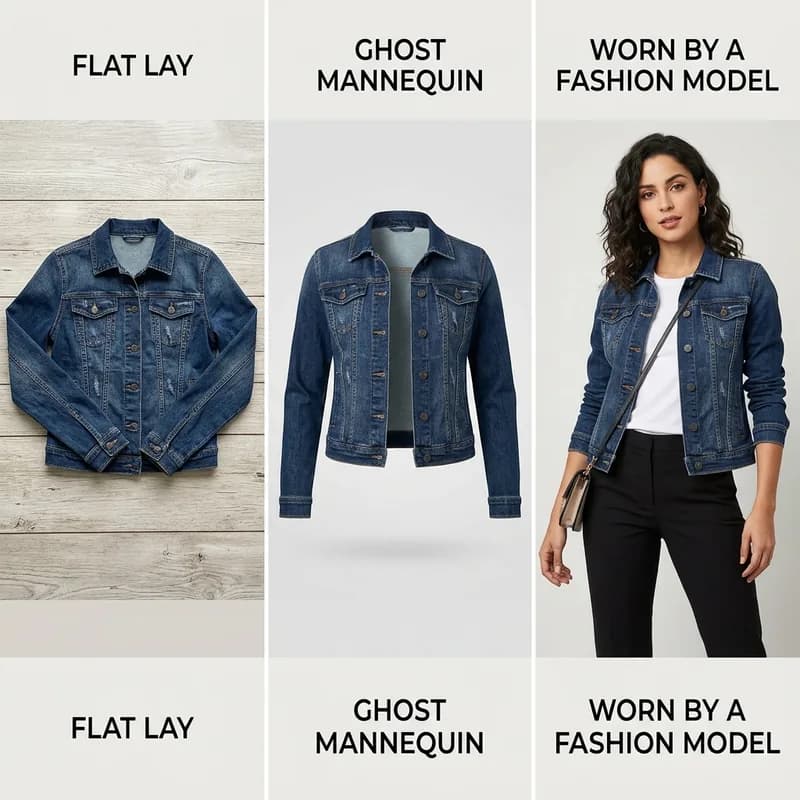
A t-shirt can be photographed three ways: laid flat on a surface, placed on a ghost mannequin to show its 3D shape, or worn by a model. Each approach produces a different image, serves a different buyer psychology, costs a different amount to produce, and complies differently with major marketplace rules. Choosing wrong doesn't just affect aesthetics — it affects conversion rates and potentially your ability to list on Amazon at all.
Flat Lay Photography
Flat lay is the simplest and cheapest apparel photography technique. The garment is laid on a flat surface — usually white paper, fabric, or a table — and photographed from directly above. No model, no mannequin, no special equipment beyond a camera and a light source.
Pros
- Lowest production cost: No model fee, no mannequin, no studio setup beyond a clean flat surface. Brands with limited budgets can shoot flat lay in-house with basic equipment.
- Fast to produce: A skilled in-house photographer can shoot 50–100 flat lay garments per day. Ghost mannequin and on-model both require more preparation per garment.
- Works well for accessories and folded items: Knitwear, scarves, hats, socks, and folded denim often look better flat than on a mannequin because the 3D mannequin shape is less relevant to how those products are worn.
- Consistent grid aesthetics: Flat lay lends itself to visually consistent catalog grids where every image sits on the same plane and can be cropped to identical dimensions easily.
Cons
- Low conversion for structured garments: A blazer, a structured dress, or a tailored shirt looks flat and lifeless laid on a table. The shape that makes it desirable — how it fits, how it drapes — is invisible in a flat lay. Multiple industry studies show flat lay converts at lower rates than ghost mannequin or on-model for most structured apparel.
- Not compliant for Amazon clothing main images: Amazon requires that apparel main images show the garment on a model or mannequin in most clothing categories. Flat lay fails this requirement and will cause listing suppression.
- Crease and drape issues: Getting a flat lay to look clean requires careful styling — garments wrinkle, pull, and bunch when laid flat in ways they wouldn't when worn. Either significant in-shoot styling time or post-production editing is needed to address this.
Best for:
Accessories (scarves, hats, folded knitwear), lifestyle brands on Shopify where the aesthetic matches the editorial style, DTC brands who are not yet on Amazon, social content and lookbook supplementary images.
Ghost Mannequin (Invisible Mannequin)
Ghost mannequin — also called invisible mannequin or neck joint — is a post-production technique where a garment is photographed on a physical mannequin from multiple angles, and the mannequin is then digitally removed in editing. The result is a 3D image of the garment appearing to float, showing its shape, drape, and construction as if worn by an invisible body.
Pros
- Shows garment shape without a model: The primary advantage of ghost mannequin over flat lay is that it captures the 3D volume and drape of a garment — how it would actually look when worn — without the cost of hiring, scheduling, and shooting with a model.
- Amazon compliant for apparel: Ghost mannequin satisfies Amazon's requirement that clothing main images show the garment on a model or mannequin. It's the standard technique for fashion brands without model photography budgets.
- Neutral product presentation: Because there's no model, the viewer's attention stays entirely on the garment. No skin tone, body type, or facial expression to potentially misalign with a buyer's self-image. This can improve conversion breadth across diverse customer segments.
- Consistent aesthetic at scale: Ghost mannequin images are visually consistent across a catalog in a way that on-model images often aren't — no variation in model pose, expression, or body positioning between garments.
- More affordable than on-model at volume: Once you have the mannequin and a shooting workflow, the per-garment shoot cost is lower than model photography. Post-production is the main cost, starting from $0.75/image for standard garments.
Cons
- Requires multi-angle photography: To create a convincing ghost mannequin image, you need to photograph the front, back, and interior neck/collar of each garment. This adds shooting time compared to flat lay.
- Post-production dependency: The quality of a ghost mannequin image depends entirely on the quality of the editing. Poorly executed ghost mannequin — visible seams at the neck joint, inconsistent interior colour, mismatched lighting — looks worse than flat lay. Good ghost mannequin requires a skilled editor.
- Less aspirational than on-model: In fashion categories where brand aspiration drives purchase decisions — premium streetwear, luxury fashion, activewear — ghost mannequin can feel clinical compared to lifestyle-oriented on-model images.
Best for:
Fashion e-commerce brands on Amazon, mid-market apparel brands with consistent catalog needs, Shopify stores in structured garment categories (shirts, jackets, dresses, knitwear), brands that need to show garment construction and fit without model photography costs.