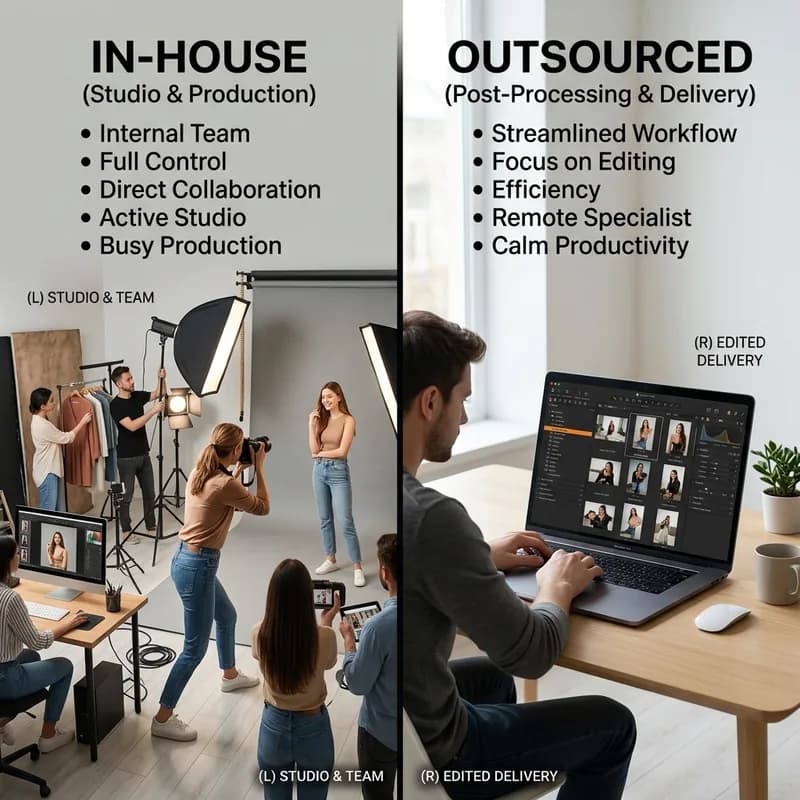
At some point, editing your own product photos stops making sense. Maybe you're processing 50 SKUs a week and spending three hours a night in Photoshop. Maybe your catalog has scaled to the point where inconsistency is creeping in — different editors, different sessions, different results. Outsourcing solves the volume problem, but only if you set it up correctly. Most first-time outsourcing attempts fail not because the service is bad, but because the brief is.
Step 1: Know What You're Outsourcing Before You Start
Product photo editing is not one service — it's several, and the right provider depends on which ones you need. Before contacting any studio, be specific about what you're sending:
- Background removal only: Isolating the product on a transparent or white background. The fastest, cheapest, and most commonly outsourced operation. Volume pricing starts around $0.29/image for hard-edge products.
- Clipping path: Manual Pen Tool isolation for products that need precision edges — bags, shoes, hard goods. Different from AI background removal; ask explicitly for "manual clipping path" if you need it.
- Ghost mannequin: Multi-shot composite for apparel. Requires you to photograph the garment from front, back, and interior collar before sending. Can't be created from a single shot.
- Full retouching: Color correction, blemish removal, wrinkle reduction, shadow addition. Significantly more time-intensive and priced accordingly.
- Batch color correction: Normalising white balance, exposure, and color profile across a catalog. Often ordered as a separate pass after background removal.
Mixing these into a single vague "edit my photos" request is the most common briefing mistake. A studio that quotes $0.49/image for background removal will produce very different work than one that interprets the same price as including full retouching.
Step 2: Prepare Your Files Before You Send Anything
The quality of what you get back is ceiling-limited by what you send. Before uploading your first batch:
File Format
Send RAW files (CR2, NEF, ARW) whenever possible for any retouching or color correction work. RAW files preserve full sensor data — editors have maximum latitude to correct white balance and exposure without degrading image quality. For background removal only on already-processed files, high-resolution JPEG at 90%+ quality or TIFF is acceptable.
Resolution
Send files at full camera resolution. Do not resize before sending. A 24-megapixel file edited at full resolution and then downscaled to 2000×2000 for Amazon will always look sharper than a 2000×2000 file edited at that size. Editors working at full resolution have pixel-level working room at edges that simply doesn't exist in a downscaled file.
File Naming
Name files consistently before sending. A clear naming convention — product-sku-angle.jpg (e.g., BLK-TOTE-001-front.jpg, BLK-TOTE-001-back.jpg) — eliminates ambiguity about which file is which and which shots belong together for ghost mannequin compositing. Unnamed or generically-named files (DSC_4821.jpg) slow down production and increase error risk.
Folder Structure
Organise by product, not by date or camera card. One folder per SKU for ghost mannequin work. One folder per product category if you're sending mixed product types. Include a README.txt in the root folder with basic context: what the products are, what marketplace they're going to, and which output format you need.
Step 3: Write a Brief That Actually Controls the Output
A brief is not a description of your products — it's a set of specifications that tells the editor exactly what the finished file should look like. A good brief answers five questions:
1. What is the output background?
Be specific. "White background" means different things to different people. For Amazon compliance, the spec is RGB 255,255,255 exactly — pure white, not off-white, not near-white. Say: "Pure white background, RGB 255,255,255, Amazon main image compliant." For Shopify, if you want a specific hex colour, provide it.
2. What are the output dimensions and file format?
State the exact pixel dimensions, aspect ratio, resolution (DPI), and file format you need. Example: "2000×2000 px, 1:1 square, 72 DPI, sRGB, JPEG at 90% quality and PNG with transparent background — both versions for each image." If you need multiple sizes for different platforms, list all of them.
3. What does the product fill within the frame?
Amazon requires the product to occupy at least 85% of the frame. Some brands prefer 80% for breathing room. State this. "Product fill: 85% of frame, centred." Without this, editors make their own judgment and your images will be inconsistent across the catalog.
4. What is the retouching scope?
List exactly what should and should not be done. "Remove background to pure white. Correct white balance. Remove dust and sensor spots. Do not alter product colour, shape, or texture. Add a natural drop shadow." Editors will not guess at what you want beyond what they're explicitly briefed for.
5. What are the reference images?
Include 2–3 examples of previously edited images that represent the style you want. Reference images are worth more than any written description. If you don't have your own examples, find 2–3 competitor or brand images from Amazon or Shopify that show exactly the edit style you're targeting and include them in your brief folder.
Step 4: Always Run a Test Batch First
Never send a full catalog on the first order with a new studio. Send 5–10 representative images — your most complex product types, your trickiest angles, anything that would expose quality issues — and evaluate the output before committing volume.
In a test batch, check specifically for:
- Edge quality: Zoom to 200% at the product perimeter. No halos, no jagged edges, no missing detail at fine areas (fabric edges, hair, chain links).
- Background accuracy: Use the eyedropper tool in Photoshop to sample the background. It should read 255,255,255 if that was specified — not 253,253,253, not 250,250,250.
- Colour accuracy: Compare the edited image against the physical product in natural daylight. The edited version should match, not be warmer, cooler, or more saturated.
- Consistency: All images in the test batch should look like they came from the same studio at the same settings. If some look warmer and some cooler, or some have tight crop and some have loose crop, the studio doesn't have a consistent workflow.
- File output compliance: Check that delivered files match the specs you provided: correct dimensions, correct format, correct colour profile embedded.
Good studios expect test batches and process them quickly — often within a few hours. If a studio resists a test batch or insists you commit volume first, that's a red flag.
Step 5: Understand Realistic Turnaround Times
Turnaround expectations vary significantly by service type and volume:
- Background removal, small batch (under 50 images): 12–24 hours standard, same-day possible with a rush fee
- Background removal, large batch (200–500+ images): 24–48 hours standard
- Ghost mannequin (per garment): 24 hours standard; complex multi-piece composites may need 48 hours
- Full retouching (per image): 24–48 hours depending on complexity
- Batch color correction: 24 hours for most catalog sizes
Be cautious of studios promising 4–6 hour delivery on anything above 50 images for a first order. Genuinely fast delivery on large first-time orders sometimes means AI-only processing without human QA — which produces acceptable results on simple products and poor results on anything complex.
Red Flags to Watch For
- No sample work available: Any professional studio can show before/after examples across different product types. If they can't or won't, they don't have an established workflow.
- No revision policy: Studios confident in their work offer at least one revision round. No revision policy means no accountability for misses.
- Vague pricing: "$0.25 per image" with no breakdown of what's included invites misunderstandings. Get explicit scope in writing before placing an order.
- AI-only for complex products: If you're sending jewellery, glass, fur, or apparel and the studio doesn't mention human editing, assume they're using automated tools. Ask directly: "Do human editors touch every file, or is this AI-processed with human QA?"
- No dedicated contact: Volume e-commerce editing requires a consistent point of contact who understands your style guide and can escalate quality issues. Studios with only a generic inbox create friction when problems arise.
How to Scale the Relationship Over Time
The most efficient outsourcing relationships are built over 3–6 months, not 3–6 orders. Once a studio has processed your catalog, they know your products, your style, and your edge cases — and quality improves while turnaround time often shortens. Jumping between studios for marginal price differences resets this every time.
Set up a running style guide document — a shared Google Doc or PDF — that your editing partner can reference and that you update as your brand standards evolve. Include: approved background samples, approved shadow styles, crop percentage targets, colour reference swatches for your most frequently edited products, and examples of edits you've rejected and why.
BLACKFOX DIGITAL works with e-commerce brands on exactly this model. We process test batches within 24 hours, assign a dedicated account contact to every regular client, and maintain your style guide file on our end so you don't need to re-brief on every order. Background removal from $0.29/image. Full retouching from $0.85/image. Submit 5 images free to see the output quality before committing to anything.