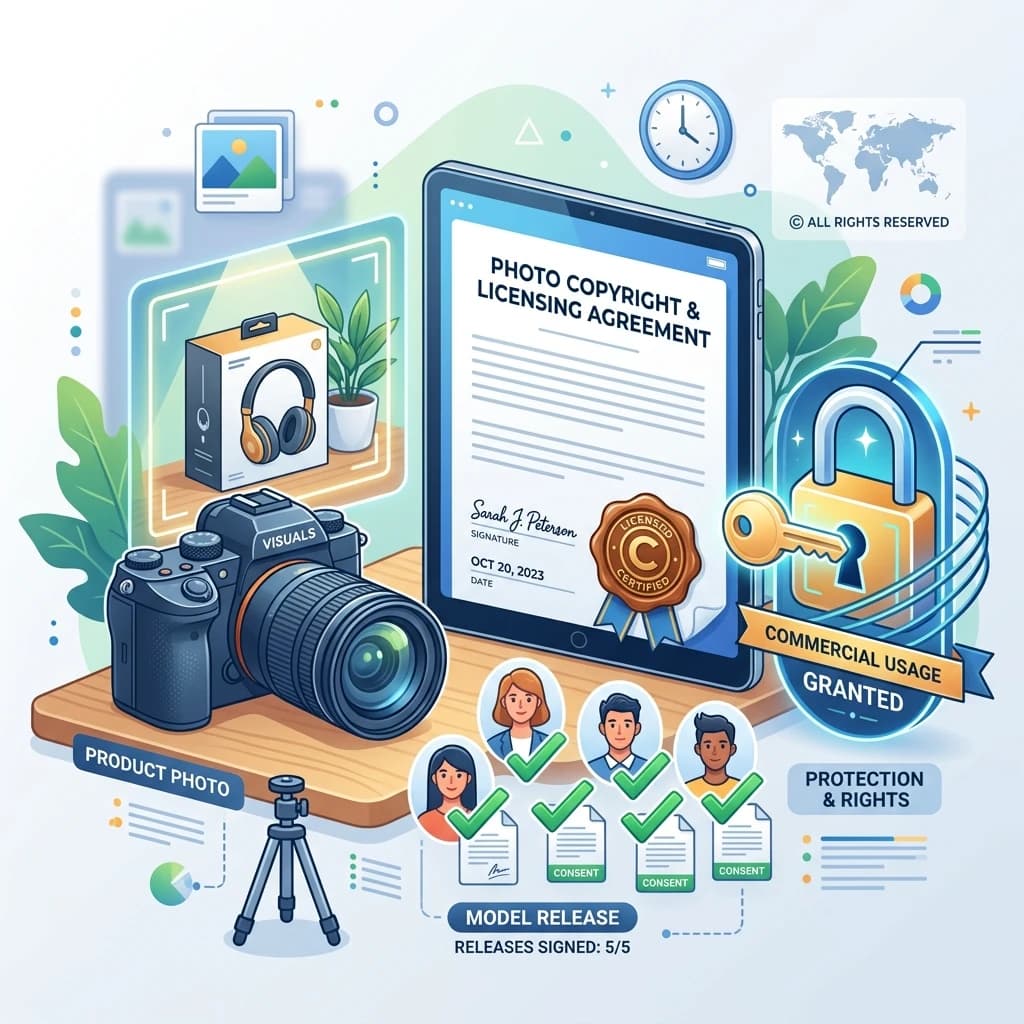
In e-commerce, using the wrong image can cost you far more than a bad conversion rate — it can trigger a DMCA takedown, a rights holder lawsuit, or an account suspension on Amazon, Etsy, or Shopify. Many sellers assume that because they paid for a photoshoot, they own the resulting images. Under copyright law, that assumption is frequently wrong. This guide covers what you actually need to know about product image rights, licensing, model and property releases, stock image rules, AI-generated backgrounds, and how to protect yourself from costly legal mistakes.
Who Owns a Product Photo: Client vs. Photographer
Under copyright law in most jurisdictions — including the United States, the European Union, and the United Kingdom — the person who creates an original work is its copyright owner by default. That means the photographer, not the brand that commissioned the shoot, owns the images from the moment they are taken. Paying a photographer does not transfer copyright unless a written agreement explicitly says so.
There are two legitimate ways to acquire full rights to your product images:
- Work-for-hire agreement: A written contract specifying that all images created are owned outright by the client from the moment of creation. This is the cleanest arrangement for e-commerce brands. It must be in writing — verbal agreements offer little protection. For independent contractors, a work-for-hire clause must be explicitly included; it does not apply automatically.
- Licence agreement: The photographer retains ownership of the copyright but grants you permission to use the images under defined terms. The scope of that permission varies widely depending on what you negotiate. This is more common when working with established photographers who retain their portfolio rights.
If you have neither a work-for-hire agreement nor a written licence, your legal right to use the images may be limited to what was implied by the business relationship — and implied rights are difficult to enforce and easy to dispute.
What "All Rights" vs. "Limited Licence" Means in Practice
When a photographer offers a licence, the scope matters enormously. Always clarify the following before the shoot or before receiving deliverables:
- All rights / unlimited commercial licence: You may use the images across any channel, in perpetuity, in any country, and may modify or sublicence them without restriction. This is the arrangement most e-commerce brands should aim for.
- Limited licence: Restricts use to specific platforms (e.g., Amazon only), specific time periods (e.g., 12 months), specific territories, or specific print runs. Using images beyond the licence scope is copyright infringement, even if you paid for the original shoot.
- Exclusivity: A non-exclusive licence means the photographer can sell or licence the same images to other parties, including competitors. An exclusive licence prevents this but typically costs more.
Get the licence terms in writing and review them before publishing images anywhere. Many disputes arise because sellers assumed "all rights" when they received only "web use".
Model Releases: When You Need One, What It Covers, and What Happens Without One
If any recognisable person appears in your product images — including a hand, a face partially visible in a mirror, or a model wearing your product — you need a signed model release before using that image commercially.
A model release is a legal document in which the individual grants permission for their likeness to be used in commercial contexts. Without it, the person depicted can claim a violation of their right of publicity (in the US) or personality rights (in the EU and UK), which can result in injunctions, damages, and removal of your listings.
- When you need it: Any commercial use of an image featuring a recognisable person — including advertising, product listings, social media posts, and press materials.
- What it must cover: The scope of commercial use, any compensation paid to the model, confirmation that the model is of legal age (or parental consent for minors), and the model's signature.
- What happens without one: If a platform receives a rights complaint citing an unlicensed likeness, your listing can be taken down regardless of whether you believe the claim is valid. Resolving such disputes is expensive and time-consuming.
Professional retouching studios that produce model imagery — such as our e-commerce photo editing service — should be able to confirm that all model releases are in place before delivering images for commercial use.
Property Releases: Location Shoots and Recognisable Buildings or Art
Property releases are required when your images feature recognisable private property, trademarked logos or branding visible in the background, or architectural works that are subject to copyright. In the US, buildings visible from public space are generally safe to photograph for commercial use; in the EU, the rules vary by country under "freedom of panorama" provisions.
For lifestyle product shoots on private property — a rented studio, a restaurant, a private home — confirm with the property owner that you have permission for commercial photography before the shoot begins. Doing so after the fact is difficult and may require reshoot costs.
Stock Images as Product Backgrounds: What Licences Allow Commercial Use
When backgrounds are swapped in post-production (replacing a product's original background with a stock environment), the licence governing the background image applies just as strictly as the product photo licence. Common sources and what they allow:
- Getty Images and Adobe Stock: Paid commercial licences that permit use in advertising and product listings. Read the extended licence terms for uses that go beyond standard digital advertising (such as items for resale featuring the image).
- Shutterstock and iStock: Similar commercial licence structures. Subscription plans typically cover standard commercial use; enhanced licences are required for unlimited print runs or broadcast use.
- Unsplash: Free to use, including commercially, under the Unsplash licence. However, images are not exclusive — the same image may appear in a competitor's listing — and third-party elements within an Unsplash photo (a person, a trademarked object) may carry separate rights that Unsplash's licence does not cover. Use with care for product backgrounds.
- Free image sites without explicit commercial licence: Avoid. "Free to use" and "free for commercial use" are not the same thing. Unlicensed use of a commercially restricted image is infringement regardless of how you obtained the file.
AI-Generated Backgrounds: The 2026 Legal Position
AI-generated images currently occupy an uncertain legal position. As of 2026, the US Copyright Office's position is that purely AI-generated content — images produced without meaningful human creative authorship — is not eligible for copyright protection. The EU's AI Act and UK copyright law are moving in a similar direction, though specific jurisdiction rules vary and continue to evolve.
What this means in practice:
- You can generally use AI-generated backgrounds commercially without licensing fees — there is no rights holder to pay.
- You cannot prevent competitors from using the same AI-generated image, since there is no copyright to enforce.
- AI tools that incorporate stock images or copyrighted training data may produce outputs that contain embedded copyrighted elements — this is a legal grey area. Consult the terms of service of the AI tool you use.
- Using AI to add realistic-looking human models to product images raises right-of-publicity questions if the generated likeness resembles a real person. Use clearly fictionalised likenesses to avoid claims.
Supplier and Manufacturer Images: Why You Cannot Just Use Them
When you resell a brand's product, you may be tempted to use the manufacturer's product images from their website or catalogue. Unless the manufacturer has explicitly granted resellers permission to use their images, doing so is copyright infringement. The manufacturer owns the copyright to their product photography, and many large brands actively monitor for unauthorised use.
On Amazon, using manufacturer images without authorisation can result in a DMCA notice that gets your listing removed and, if repeated, risks account suspension. On Shopify and independent stores, it exposes you to civil copyright claims. Always confirm image usage rights before using any supplier-provided images in your listings.
DMCA Takedown Risk for E-Commerce Sellers
The Digital Millennium Copyright Act (DMCA) gives rights holders a fast, low-cost mechanism to have infringing content removed from platforms. Amazon, Etsy, eBay, and Shopify all comply with DMCA takedown requests quickly and typically remove the content first and resolve disputes later. This means:
- A single valid DMCA notice can take down your listing within 24–48 hours, regardless of how long you have been selling.
- Repeated DMCA notices can result in permanent account suspension.
- Reinstating a listing after a takedown requires filing a counter-notice, which takes time and may not succeed if the original claim was valid.
The fastest way to reduce DMCA risk is to ensure every image in your listings is either owned outright (with a written agreement), covered by a clear commercial licence, or created specifically for you with releases in place.
Practical Checklist: What to Confirm Before Publishing
Before uploading any product image to a listing, confirm all of the following:
- Do you have a signed work-for-hire agreement or written commercial licence for the images?
- Does the licence cover all platforms and territories where you will publish?
- Do you have signed model releases for every recognisable person in the images?
- Do you have property releases for any private locations, artwork, or trademarked elements in the background?
- Are all background images licensed for commercial use with no geographic or time restrictions?
- If AI-generated elements are present, have you reviewed the AI tool's terms of service for commercial use?
- Did you verify that you are not using any supplier or manufacturer images without explicit written permission?
Note: This article provides general educational guidance on product image rights and licensing. It does not constitute legal advice. For questions specific to your situation — particularly around contracts, infringement disputes, or jurisdiction-specific rules — consult a qualified intellectual property attorney.
Working with a professional retouching studio is one of the most effective ways to ensure your product images are created cleanly and with the appropriate rights in place. Our e-commerce photo editing service delivers consistent, professionally retouched product images at scale — and we can advise on the documentation you need before images go live on your listings. Submit 5 images for a free trial batch to review quality and process before committing your full catalogue.