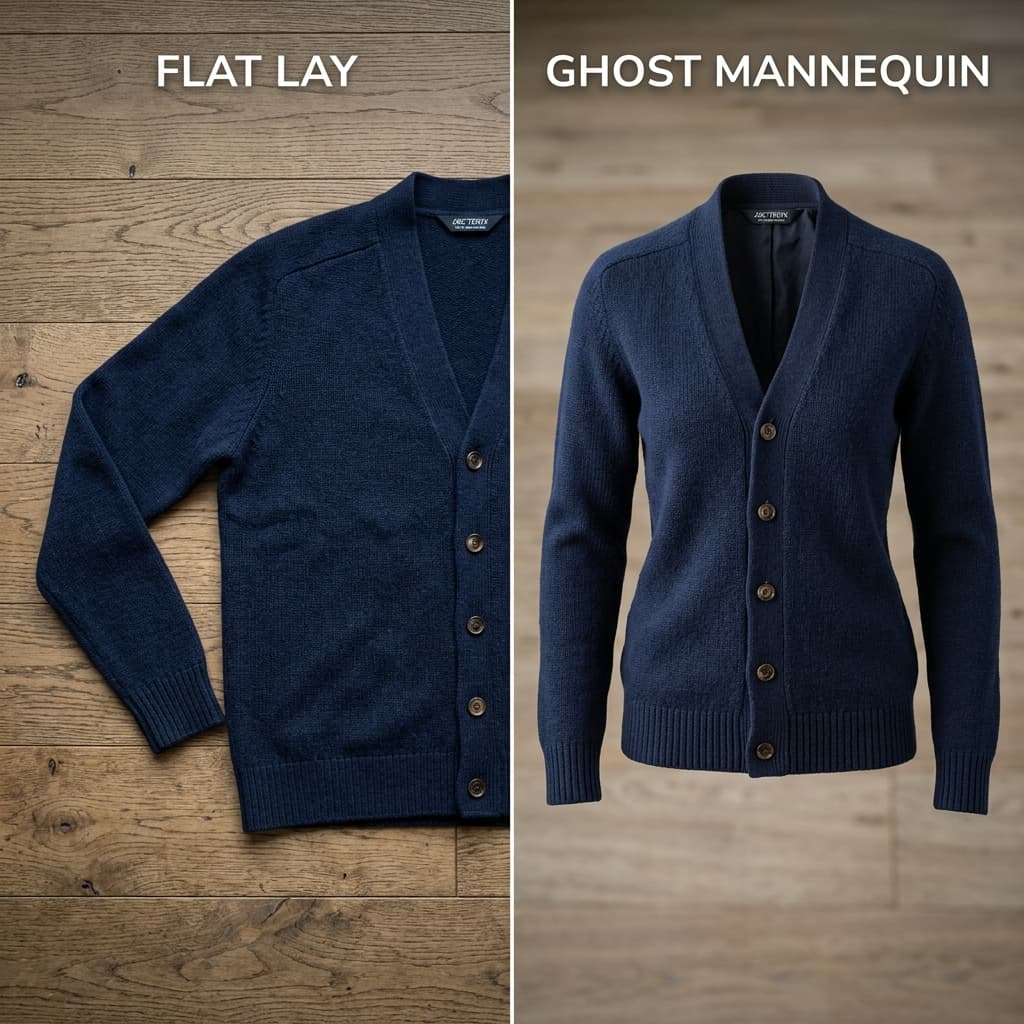
Two garments, two completely different photography techniques — and picking the wrong one costs you conversions or gets your listing rejected. Here's how to decide, garment by garment.
Every apparel brand eventually hits the same fork in the road: shoot this garment as a ghost mannequin, or lay it flat? The two techniques look superficially similar — both remove the model from the equation — but they solve different problems, cost different amounts, and aren't interchangeable on most marketplaces. Picking the wrong one for a given garment either tanks conversion or gets the listing rejected outright. Here's how to choose, and how to avoid the mistakes that make even the right technique look wrong.
What Is Ghost Mannequin Photography
Ghost mannequin — also called invisible mannequin — is a composite technique. The garment is photographed on a physical mannequin from multiple angles (front, back, and the interior neckline or waistband), and the mannequin is digitally removed in post-production. The interior shot is blended into the neck or waist opening so the garment appears to float with full 3D shape and structure, as if worn by an invisible body.
The result shows how a garment actually drapes, fits, and holds its form — information a flat photo simply can't convey.
What Is Flat Lay Photography
Flat lay is the opposite of complicated: the garment is laid on a flat surface — usually seamless paper, fabric, or a table — and photographed straight down from above. No mannequin, no compositing, no neck-joint reconstruction. What the camera captures is what you publish, after basic retouching.
It's the fastest and cheapest way to photograph apparel, and for the right product category, it's also the right choice.
Ghost Mannequin: Pros and Cons
Pros
- Shows true garment structure. Collars sit the way they're meant to sit, sleeves hang with real drape, and the overall silhouette reads as 3D rather than a flattened shape on a table.
- Communicates fit without a model. Buyers get a much clearer sense of how a structured piece — a blazer, a fitted dress, a tailored shirt — will actually look worn, without the cost of a model shoot.
- Marketplace-compliant for apparel main images. Most major marketplaces accept ghost mannequin as a valid format for the primary listing image, where flat lay is rejected outright (more on this below).
Cons
- More expensive than flat lay. It requires multiple source shots per garment (front, back, interior) and a skilled editor to blend the neck joint and reconstruct shadow and texture convincingly.
- Needs real post-production skill. A poorly executed ghost mannequin — a visible seam at the collar, mismatched interior lighting, a flattened or unnatural drape — looks worse than a clean flat lay. This isn't a technique you can shortcut with one-click background removal; we cover why automated tools struggle with structured garments in our guide to how the ghost mannequin effect actually works.
Flat Lay: Pros and Cons
Pros
- Fast and cost-effective. No mannequin, no multi-angle capture, no compositing. A photographer can shoot dozens of garments per day with basic equipment.
- Works well for accessories and unstructured pieces. Scarves, folded knitwear, hats, socks, and flat goods often look better laid flat than forced onto a mannequin shape that doesn't apply to how they're worn.
Cons
- Loses garment shape entirely. A structured jacket or fitted dress photographed flat looks lifeless — the drape, volume, and fit that drive a purchase decision simply aren't visible.
- Not accepted as a main image on most apparel marketplaces. This is the mistake that catches brands off guard most often, covered in detail below.
On-Model: The Third Option, Briefly
On-model photography — a real person wearing the garment — sits above both techniques in cost and below both in production speed, but it's the only format that shows true fit and styling context. It's the right call for fit-sensitive categories like swimwear, lingerie, and activewear, and for brands where aspirational lifestyle imagery is core to the sale. We compare all three formats side by side, including conversion data, in flat lay vs ghost mannequin vs on-model: which converts best. This guide focuses specifically on choosing between ghost mannequin and flat lay for the bulk of a catalog.
Decision Matrix: Which One for Which Garment
- Structured outerwear (jackets, blazers, coats): ghost mannequin — shape and drape are the entire selling point.
- Tailored shirts and dresses: ghost mannequin — fit and silhouette need to read clearly.
- Knitwear, sweaters: either works; ghost mannequin shows volume better, flat lay is faster and acceptable for secondary images.
- Scarves, hats, folded accessories: flat lay — there's no meaningful 3D shape to show.
- T-shirts and basics: flat lay for budget catalogs and secondary images; ghost mannequin if the main image needs marketplace compliance.
- Tight or fit-sensitive garments (swimwear, lingerie): neither — use on-model.
- Budget-constrained startup catalog: flat lay for non-main images, ghost mannequin reserved for hero/main images only.
Marketplace Rules: Where Flat Lay Gets Rejected
This is the rule that trips up the most sellers, because it isn't optional:
- Amazon requires apparel main images to show the garment on a model or mannequin in most clothing categories. A flat lay submitted as the main image will fail Amazon's image requirements and can result in listing suppression.
- Zalando applies the same standard for supplier-submitted apparel images — flat lay is rejected as a main image and is only acceptable as a supplementary or detail shot.
- ASOS follows the same logic for seller-submitted product imagery — main apparel images need to show the garment's worn shape, whether via mannequin or model.
The practical implication: if you're selling structured apparel on any of these marketplaces, flat lay can only ever be a secondary or detail image. Your main image needs to be ghost mannequin or on-model, full stop.
Cost Comparison
- Flat lay: cheapest by a wide margin — minimal shoot time, no compositing, fastest turnaround.
- Ghost mannequin: mid-range — multiple source shots per garment plus skilled post-production, but still significantly cheaper than a model shoot once you're working at catalog volume.
- On-model: most expensive — model fees, styling, and a full production day push per-garment cost well above either alternative.
When comparing these costs, count the whole catalogue rather than a single garment. A format that is slightly cheaper per item but needs reshoots for marketplace compliance, or drives more size-related returns, can end up costing more over a season than the option that looked more expensive at the quote stage.
Common Mistakes
- Using flat lay as the main image for structured apparel on Amazon, Zalando, or ASOS. An instant compliance failure, not a stylistic preference — check your marketplace's image requirements before you shoot, not after the listing gets flagged.
- Skipping the interior/neckline shot for ghost mannequin. Without it, editors have nothing to blend into the opening, and the final image shows a visible gap or a fabricated interior that looks artificial.
- Forcing flat lay on structured pieces to save money. The savings on the shoot get eaten by lower conversion — buyers can't evaluate fit or drape from a flat image of a blazer or fitted dress.
- Inconsistent styling across a flat lay catalog. Wrinkled or unevenly arranged garments are far more visible flat than on a mannequin, and inconsistent folding between SKUs makes a catalog look unpolished.
- Underestimating ghost mannequin post-production time. Treating it like a simple background removal job rather than a multi-shot composite leads to rushed, visibly flawed neck joints.
When to Outsource
Flat lay retouching is simple enough that many small catalogs handle it in-house. Ghost mannequin is a different proposition at scale: multi-angle capture plus neck-joint compositing per SKU adds up fast, marketplaces expect uniform shadow and drape treatment across an entire collection, and new collection drops need faster turnaround than most in-house teams can sustain.
Our ghost mannequin editing service handles the full workflow — mannequin removal, neck-joint reconstruction, shadow and texture matching — at production scale, so structured garments get marketplace-compliant main images without slowing down your shoot calendar.
Decision Guide: Matching Format to Garment Type
Ghost mannequin is the default choice for structured, tailored, or layered garments where silhouette and construction are selling points: blazers, coats, knitwear, denim jackets, and formal wear. Flat lay works well for lightweight, unstructured pieces where texture and print are the primary features: t-shirts, casual tops, scarves, and accessories.
Some products genuinely warrant both formats. A structured shirt may show collar construction best with ghost mannequin for the main image and flat lay for lifestyle-style secondary shots. Platforms like Pinterest and Instagram also tend to perform better with flat lays, while Amazon and Zalando main-image requirements effectively mandate ghost mannequin for structured categories.
Budget plays a role: flat lay production cost per unit is lower and easier to scale in-house. Ghost mannequin requires a two-shot workflow and composite editing per SKU, which adds cost and time. For brands processing 50+ SKUs per season, outsourcing ghost mannequin editing to a specialist service typically costs less per image than building the in-house capacity. Send us 5 garments free to test quality and turnaround before committing to a volume order. We cover all garment types including structured tailoring, knitwear, denim, and outerwear, with a guaranteed 24-hour standard delivery and fully manual clipping paths applied on every single image.